7 Reasons Your Kick Tires You Out Faster Than Your Pull
Quick Answer: In freestyle, the kick contributes roughly ten to fifteen percent of forward propulsion while consuming a disproportionate share of your oxygen, because leg muscles are large, oxygen-hungry, and working against water resistance in a direction that mostly generates lift rather than thrust. Add a knee-driven kick, stiff ankles and an over-large amplitude and the cost climbs while the return does not. Fixing kick efficiency is almost always about doing less, not more.
This single misunderstanding accounts for more early fatigue than technique in the arms ever does.
This blog has covered why your swim feels harder in late summer than it did in June, the breathing pattern that comes before speed, and nine signs your technique is wasting energy rather than making you slow. This one is about your legs specifically.

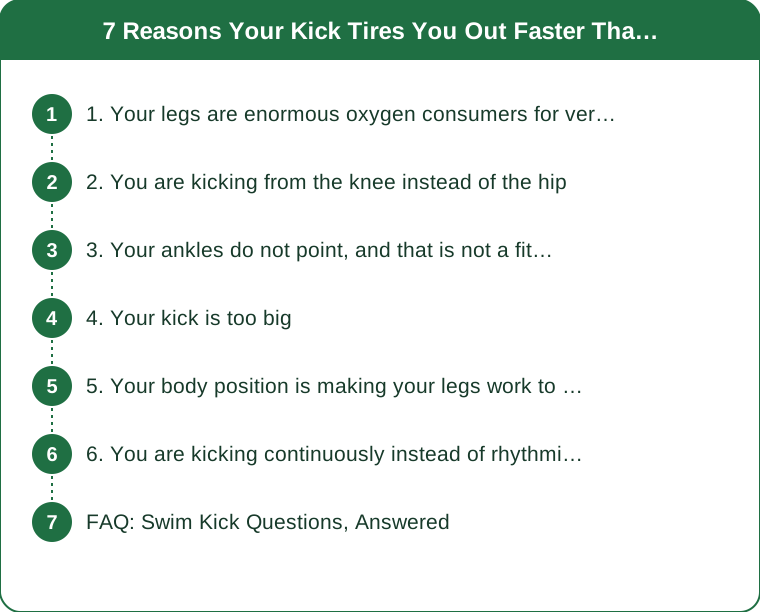
1. Your legs are enormous oxygen consumers for very little return
The quadriceps and glutes are the largest muscles in the body, and size determines oxygen demand more than effort does.
A hard kick can consume a large share of your total oxygen uptake while producing a small share of your forward speed. That trade is the fundamental problem, and no amount of fitness makes the ratio good.
Distance swimmers kick lightly on purpose. A two-beat kick in long-distance freestyle exists to stabilise the body roll, not to push you forward.
Sprinters kick hard because they can afford to. Over fifty metres the oxygen cost never comes due. Over a thousand it absolutely does.
If you finish a set breathless with legs burning and arms fine, this ratio is the whole explanation.
2. You are kicking from the knee instead of the hip
The most common fault in adult swimmers, and the most expensive one.
A knee-driven kick bends the leg through a large range and presents the shin to the water like a brake. You generate drag on the recovery of every single kick.
A hip-driven kick keeps the leg relatively straight with a small, whip-like bend that comes from the water pressure rather than from you.
The tell is your own perception of effort. If you can feel your quadriceps burning specifically at the front of the thigh, the knee is doing the work.
Kicking with a board makes this worse, not better, because holding a board flattens the hips and encourages exactly the bent-knee pattern you are trying to remove.
3. Your ankles do not point, and that is not a fitness problem
Ankle flexibility determines whether your foot is a paddle or a bucket.
A pointed foot presents an angled surface that pushes water backwards. A flexed foot presents a flat surface that pushes water forwards, actively slowing you.
Runners and cyclists usually have the stiffest ankles of anyone in the pool. Years of dorsiflexion-dominant training produce exactly the range restriction that swimming punishes.
This is trainable but slow. Two to three minutes a day of seated ankle circles and gentle plantarflexion stretching produces meaningful change over six to eight weeks.
In the short term, reduce your kick rather than fighting it. A small kick with stiff ankles is far cheaper than a big kick with stiff ankles.

4. Your kick is too big
Amplitude is the variable everyone gets wrong in the same direction.
Your feet should stay within the shadow of your body, roughly a thirty to forty centimetre total range between the top and bottom of the kick.
A kick that breaks the surface with a big splash is wasting energy in air, which provides no resistance to push against at all.
A kick that drops below your body line acts as a brake. The deeper your feet go, the larger your frontal profile through the water.
Smaller and faster beats bigger and slower for both propulsion and oxygen cost, in almost every case at recreational speeds.
5. Your body position is making your legs work to fix it
A large share of leg fatigue is not propulsion at all. It is compensation.
Low hips create drag that the legs then try to overcome by kicking harder. The kick is not the problem; it is responding to one.
Looking forward rather than down drops the hips immediately. Your head is heavy, and where it goes the hips follow in the opposite direction.
Holding your breath sinks the legs. Full lungs float the chest and lever the hips down, which is why exhaling continuously underwater raises the legs without any leg effort at all.
Fix position first, then reassess. Many swimmers find their kick stops burning the moment their hips come up, without ever changing anything about the kick itself.
6. You are kicking continuously instead of rhythmically
The pattern matters as much as the technique.
A six-beat kick has a place, and that place is short and fast. For anything over two hundred metres, most efficient swimmers drop to two or four beats.
A two-beat kick times one downward kick to each arm pull, which stabilises body roll and costs remarkably little.
Continuous fluttering with no relationship to your arm stroke is the pattern that burns oxygen without contributing to either propulsion or stability.
Count your kicks per stroke cycle for one length. Most adult swimmers who are tiring early find they are somewhere between eight and twelve, which is far more than the distance requires.
7. You have trained the kick as fitness rather than as skill
Kick sets feel productive, and they can reinforce exactly the pattern you want to change.
Long kickboard sets at high effort build the knee-driven pattern under fatigue, because that is the pattern you default to when tired.
Vertical kicking in deep water is far more useful. Arms crossed, body upright, small fast kick from the hip. Thirty seconds is plenty, and there is nowhere to hide a bent knee.
Kicking on your side with one arm extended teaches the body position and the kick together, which is how they are actually used.
Fins help, if used briefly and with intent. They force plantarflexion and give immediate feedback on amplitude, but long fin sets simply mask the problem.
Myth vs Fact: Swimming and the Kick
Myth: A stronger kick makes you faster. Fact: Only in sprints. Over distance, a stronger kick mostly makes you more tired, because oxygen cost climbs faster than propulsion does.
Myth: Kickboard sets are the best way to improve your kick. Fact: They flatten the hips and encourage a knee-driven pattern. Vertical kicking and side kicking teach the movement you actually want.
Myth: Tired legs mean you need leg conditioning. Fact: Far more often they mean your hips are low and your legs are compensating for drag rather than creating speed.
FAQ: Swim Kick Questions, Answered
Why do my legs get so tired swimming when they are fine running?
Because the kick returns very little propulsion for the oxygen it consumes, and because a knee-driven kick with stiff ankles actively creates drag. Runners in particular tend to have the ankle range that swimming punishes most.
Should I kick harder to swim faster?
Over distance, almost never. Reduce the amplitude, kick from the hip, and let your arms provide the propulsion. Most recreational swimmers get faster and less tired by kicking less.
How do I know if I am kicking from the knee?
If you feel a burn specifically at the front of the thigh, or if your feet break the surface with a splash while your knees bend noticeably, the knee is driving. A hip-driven kick feels like it comes from the glutes and the whole leg.
TL;DR:
- The kick contributes ten to fifteen percent of freestyle propulsion for a much larger share of your oxygen.
- Kicking from the knee with flexed ankles turns your legs into brakes rather than paddles.
- Low hips make legs work to fix a drag problem. Look down, exhale continuously, and the burn often disappears.
- Smaller and faster beats bigger and slower. Keep the feet inside the shadow of your body.
If your legs are the thing that stops you, kicking harder is the last thing that will help.
Keep Reading
This article is for general informational purposes only and is not medical advice. It is not a substitute for professional diagnosis or treatment. Always consult a qualified healthcare provider about your individual situation, especially before making significant changes to your diet or exercise routine.