7 Reasons Your Outdoor Pool Swim Feels Different in Late August
Quick Answer: Late August water in an outdoor pool is often several degrees warmer than it was in June, and warm water limits how well you shed heat while swimming. Add longer daylight-adapted training loads, chemically tired water, more crowded lanes, and a body that has spent a full season adapting, and your perceived effort rises even when your fitness has not fallen. Most late summer slowdowns are environmental, not physical.
Here are the seven things that actually change, and what to do about each.
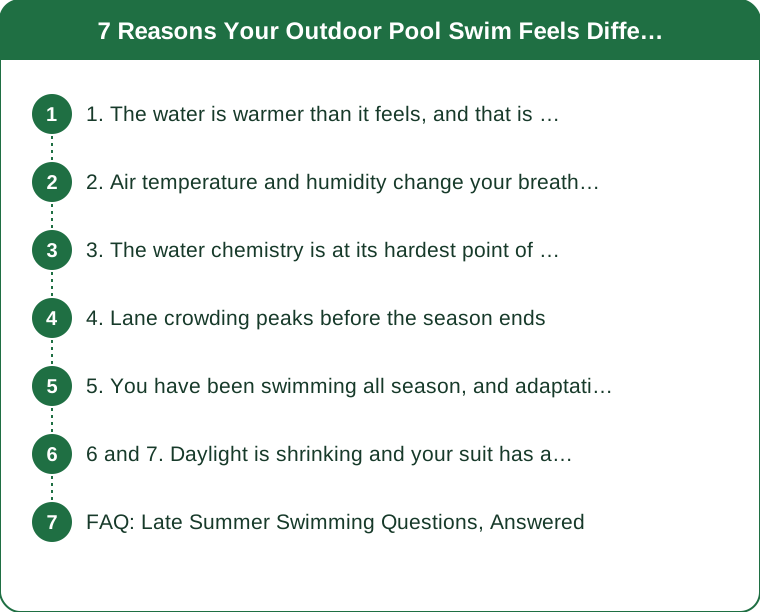
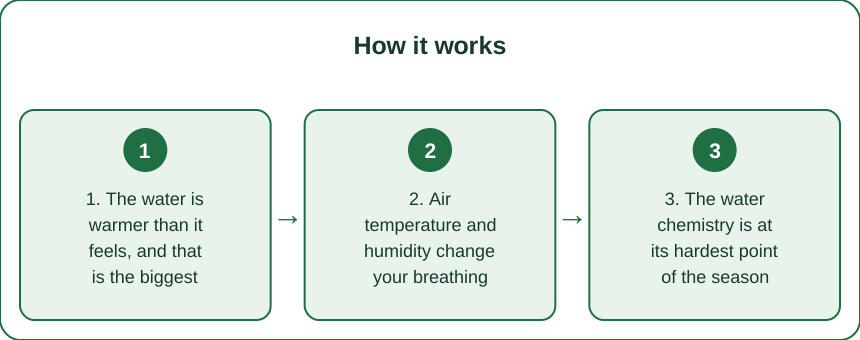
1. The water is warmer than it feels, and that is the biggest factor
An outdoor pool in late August has absorbed heat for months, and unheated or minimally heated pools frequently sit several degrees above their early summer temperature.
Why this matters more than swimmers expect: water conducts heat away from you roughly 25 times faster than air, which is normally an advantage. It is how you dump the heat your working muscles produce. When water temperature climbs toward the high twenties Celsius, that gradient shrinks and the dumping slows.
The symptoms are specific and recognisable. Your heart rate runs higher at the same pace, because circulation is being diverted toward the skin for cooling. You feel flushed rather than refreshed after a set. You get thirsty in a pool, which people rarely expect.
Competitive pools are typically kept in the mid twenties Celsius for exactly this reason, and recreational outdoor pools in late summer often drift well above that.
What to do: swim earlier, when overnight cooling has taken the edge off the surface temperature. Shorten intervals and lengthen rest rather than pushing through. Drink between sets — you are sweating, you simply cannot see it.
2. Air temperature and humidity change your breathing
You breathe air, not water, and the air over an outdoor pool in late August is warm and heavily humid.
Humid air feels harder to breathe during effort, and while the oxygen content is barely different, the perception of breathlessness rises. In swimming this matters more than in most sports because your breathing is already rationed by stroke timing — you get a window, and you take what you can in it.
The practical effect: you feel short of air at a pace that felt comfortable eight weeks ago, and the instinct is to breathe more often, which disrupts stroke rhythm and body position.
There is a second effect people miss. Warm humid air directly above warm water means almost no evaporative cooling from the exposed parts of you — your face, your back on the recovery — so even the brief cooling you get between strokes disappears.
What to do: switch to bilateral breathing every three rather than fighting a two-stroke pattern you cannot sustain, and accept a slower pace as the correct response rather than a failure. Consider dawn sessions, when air and water are both at their daily minimum.
3. The water chemistry is at its hardest point of the season
Late season pool water has been through a full summer of sun, swimmers, and heat, and it shows.
Ultraviolet light degrades free chlorine rapidly, which is why outdoor pools need stabilisers and higher dosing than indoor ones. Over a long hot season, stabiliser accumulates and chlorine becomes progressively less effective at the same measured level.
More relevant to how you feel: chloramines, the compounds formed when chlorine reacts with organic material from swimmers, are what actually cause eye stinging and the strong pool smell. Late in a busy season, with heavy bather loads and warm water accelerating reactions, chloramine levels tend to be at their highest.
Warm water also accelerates fabric degradation, which is why swimsuits bought in June look tired in August — elastane breaks down faster in warm chlorinated water than in cool.
What to do: rinse before you swim, which genuinely reduces what you contribute to the chloramine load. Rinse thoroughly afterwards, in cool water, and rinse your suit in fresh water immediately every single time. Wear well-fitting goggles and replace the seals when they harden, because stinging eyes in late season is usually chloramines rather than chlorine.
4. Lane crowding peaks before the season ends
Late August is the last stretch of outdoor pool season across most of the northern United States, and everyone knows it.
Lane density directly changes your swim. More swimmers per lane means more time spent at the wall, more overtaking, more disturbed water, and more sets broken up.
Disturbed water is a genuine physical cost, not just an annoyance. Turbulence from other swimmers increases drag and makes body position harder to hold, and swimming in someone’s wake in the wrong position costs energy rather than saving it.
Circle swimming also compresses your rest. You leave when the gap allows, not when your interval says, which quietly turns a structured set into a continuous swim.
What to do: train for time rather than distance in crowded sessions, so a broken set does not read as a failure. Go at opening or in the last hour, which in late August are noticeably quieter than the middle of the day. Choose a lane by the pace of the people already in it rather than by how empty it looks.
5. You have been swimming all season, and adaptation is not linear
A body that has trained consistently since June is a different body, and not always in the direction you expect.
Early season improvement is fast because the gains are technical, and technical gains come quickly. Late season improvement is slow because it is physiological, and physiological gains take months rather than weeks. The same effort produces a much smaller visible return by August, which reads as a plateau even when adaptation is continuing underneath.
Accumulated fatigue is a real factor by late season. Twelve weeks of consistent training without a deliberate lighter week leaves most people carrying more fatigue than they realise, and the first symptom is usually that easy paces feel harder rather than that hard paces do.
Shoulders are the specific concern. Swimming volume accumulated over a summer loads the rotator cuff repeatedly in a narrow range, and late season is when shoulder niggles appear.
What to do: take a deliberate easy week. It is counterintuitive at the end of a season and it is exactly when it works. Add rotator cuff and mid-back strength work on land, twice a week, ten minutes. If a shoulder hurts during the stroke rather than after, stop and get it looked at rather than swimming through it.
6 and 7. Daylight is shrinking and your suit has aged
Two smaller factors that both land in late August.
Daylight is contracting noticeably now. From the solstice to late August most of the northern United States loses well over an hour of evening light, and outdoor pools adjust hours accordingly. The evening session that was comfortable in July is now in fading light or gone entirely, which pushes swimmers into busier windows and disrupts routines built over the whole summer.
Circulating light change affects more than scheduling. Morning wake-up in reduced light makes early sessions feel harder, and that is a genuine circadian effect rather than a lack of willpower.
Your swimsuit is at the end of its useful life. A suit worn several times a week since May has had months of chlorine, UV, and warm water. Elastane degrades, the suit loosens, and a loose suit adds drag and rides up mid-lap — the second of which people blame on the cut rather than the age.
Signs it is done: the fabric no longer springs back, the seat looks thinner in bright light, the straps have stretched, or the colour has faded unevenly.
What to do: move your sessions rather than losing them, and take the end-of-season sales as the moment to replace a tired suit. Rotate two suits rather than wearing one, which more than doubles the life of both because elastane needs full drying time to recover.
FAQ: Late Summer Swimming Questions, Answered
Why does the same pool feel harder now than in June?
Mostly water temperature. Warmer water reduces how efficiently you shed the heat you generate, which raises heart rate and perceived effort at any given pace. Crowding, chloramines, and accumulated season fatigue add to it.
Should I keep swimming as the outdoor season ends?
Yes, and plan the transition. Indoor pools are cooler, more consistent, and less crowded in September, and the change in water temperature alone often makes paces feel better immediately.
Why do my eyes sting more late in the season?
Usually chloramines rather than chlorine, which build up with heavy bather loads and warm water. Rinsing before swimming reduces the load, and goggles with intact soft seals solve the rest.
Is it normal to be thirsty after swimming?
Completely. You sweat while swimming and cannot see it, and warm water increases the rate. Drinking during and after a session is as relevant in a pool as on a run.
TL;DR:
- Warm late season water is the single biggest reason your pace feels harder, because it limits heat loss.
- Humid air, chloramine build-up, and peak crowding stack on top of that.
- A full summer of training brings accumulated fatigue and a tired swimsuit, both of which show up now.
- Swim earlier, take a deliberate easy week, rotate two suits, and plan the move indoors rather than resisting it.
Pick one of the seven that describes your last session and change only that. It is usually the water temperature.
Keep Reading
This article is for general informational purposes only and is not medical advice. It is not a substitute for professional diagnosis or treatment. Always consult a qualified healthcare provider about your individual situation, especially before making significant changes to your diet or exercise routine.