8 Things That Change When You Move from Outdoor Swimming to Indoor Lanes
Quick Answer: Indoor pools are warmer, more humid, more chemically concentrated, and considerably more crowded per lane than outdoor water. Warmer water impairs heat dissipation, humid air makes breathing feel harder, and lane sharing changes your pacing whether you intend it to or not. The same set feels harder for reasons that have nothing to do with your fitness.
Your first indoor session after a summer outdoors felt like you’d lost a month of training. Eight things changed at once, and none of them was your fitness.
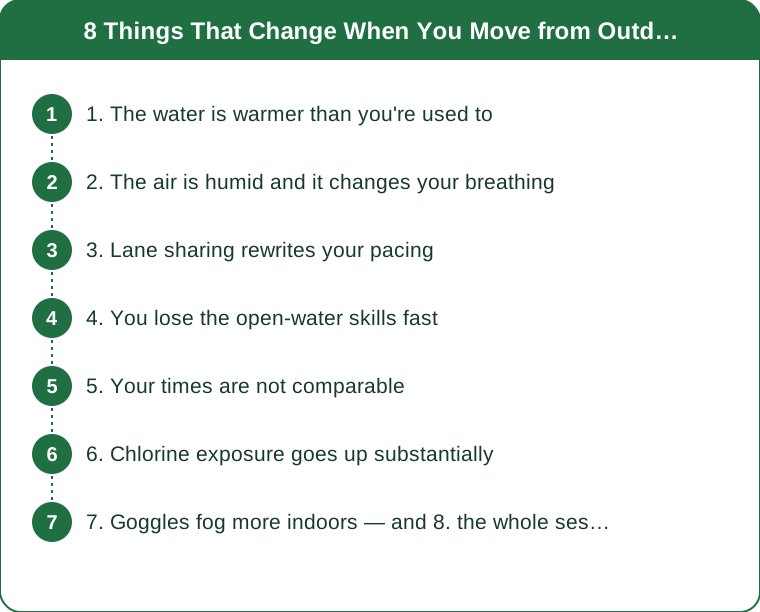
1. The water is warmer than you’re used to
This is the biggest one and the least expected.
Indoor lap pools typically run 78–82°F. Outdoor pools in late summer often sit in the low-to-mid 70s, and open water can be considerably cooler.
Warmer water impairs heat dissipation. Swimming generates significant metabolic heat, and water is your only cooling route. In 81°F water the gradient between your body and the water is small, so heat builds up during a hard set.
The result is a higher heart rate at the same pace and an earlier onset of that heavy, overheated feeling. It’s a real physiological effect, and it’s the main reason the first indoor sets feel disproportionately hard.
Hydrate as if you’re training on land. You sweat while swimming and it’s invisible. Warm indoor water plus a hard set produces genuine fluid loss that almost nobody accounts for.
2. The air is humid and it changes your breathing
Indoor pool halls run high humidity, and it’s noticeable within a few lengths.
Warm, saturated air feels harder to breathe even though oxygen availability is unchanged. The sensation of effort rises without the workload changing.
Chloramines concentrate at the water surface. These are the byproducts of chlorine reacting with organic material, and they’re what produce the strong ‘pool smell.’ They sit in a layer right above the water — exactly where you inhale.
People with any airway sensitivity notice this most. If you cough after indoor sessions and never did outdoors, chloramine exposure is the likely reason. Well-ventilated pools are dramatically better than poorly ventilated ones, and it’s worth choosing on that basis. This is general information, not medical advice — persistent respiratory symptoms warrant a professional opinion.
Breathing to both sides helps by reducing how long your face spends in the surface layer on one side.
3. Lane sharing rewrites your pacing
You are no longer setting your own pace, whatever you intended.
Circle swimming imposes the lane’s rhythm. You either match the person ahead or spend the session managing gaps. Both alter your intended pacing significantly.
Drafting is real and it distorts your sense of effort. Swimming close behind someone reduces drag noticeably, which makes an easy set feel easier and makes your times unreliable as a measure of fitness.
Pick the lane by speed, honestly. The most common source of indoor-pool frustration is one swimmer in the wrong lane. Watch for a minute before choosing.
Leave five seconds behind the person in front rather than following closely, unless you’re deliberately drafting as part of a set.
4. You lose the open-water skills fast
If you spent the summer in open water, several skills degrade quickly in a pool.
Sighting disappears entirely. In a lane you follow a black line and never lift your head, so the sighting stroke you built over summer goes unused for months.
Straight-line swimming stops being tested. The lane rope corrects you, which means any developing asymmetry in your stroke goes unnoticed until you’re back in open water next spring.
Turns replace continuous swimming. Every 25 or 50 yards you push off a wall, which breaks up the rhythm and adds a small amount of free speed from each push.
Worth preserving deliberately: swim a few lengths per session with your eyes closed for a stroke or two, or add occasional sighting strokes even in the lane. Two minutes a session keeps the skill alive through the winter.
5. Your times are not comparable
Pool swimming produces faster times, and comparing them to open water is meaningless.
Wall push-offs add real speed — several seconds across a set of 25s, and more in a shorter-course pool.
No chop, no current, no wind. Every environmental resistance is gone.
Course length matters. A 25-yard pool produces faster times than a 25-meter pool, which produces faster times than a 50-meter pool, purely from the number of turns.
Set new baselines rather than comparing across environments. People routinely conclude they’ve improved or declined when the only thing that changed was the venue.
6. Chlorine exposure goes up substantially
More time in treated water, in a more concentrated environment.
Swimsuit degradation accelerates. Chlorine breaks down elastane, and an indoor season is harder on a suit than an outdoor one. A chlorine-resistant suit — polyester or PBT rather than nylon-elastane — lasts several times longer and is worth the switch for regular indoor swimming.
Rinse the suit in cold water immediately after every swim. Not at the end of the day. This is the single biggest factor in suit lifespan.
Skin and hair take more of it. A pre-swim rinse means your hair and skin absorb clean water first and take on less pool water. It’s a 30-second step that makes a real difference.
Goggles degrade too. The anti-fog coating on the inside is consumed by chlorine and by touching. Never wipe the inside of the lens — that’s what destroys the coating.
7. Goggles fog more indoors — and 8. the whole session gets longer
Two practical ones that decide whether the indoor habit survives to November.
7. Goggles fog more indoors
A different fogging problem from the outdoor one, with a different cause.
The temperature differential is larger. Warm humid air, warm water, and a warm face all mean more condensation inside the lens than in cool outdoor conditions.
The anti-fog coating wears out, typically in three to six months of regular use. Fogging that gets progressively worse over weeks means the coating is finished, and no technique restores it.
Rinse goggles in pool water before putting them on to equalize the temperature. Simple and effective.
Don’t touch the inside of the lens. The most common way people destroy their own goggles.
Anti-fog drops work on goggles whose coating has worn out, and they’re cheaper than replacement.
8. The whole session gets logistically longer
The part nobody plans for, and the reason indoor consistency drops in autumn.
Changing, showering, and drying add 20 to 30 minutes to what was a much simpler outdoor routine in summer.
Wet hair in cold air is the new problem. Leaving a warm humid pool building into 45°F air with wet hair is genuinely unpleasant and it’s the main reason people skip early-morning autumn sessions. A hat and properly dried hair are worth the extra five minutes.
Pool schedules are more restrictive than open water was. Lane availability, class bookings, and shorter opening hours all constrain when you can swim, and they need planning that summer didn’t require.
Build the buffer into the plan. A session that took 45 minutes in summer takes 75 in autumn, and people who budget 45 stop going by November. Planning for the real duration is what keeps the habit through the season.
TL;DR:
- Indoor pools run 78–82°F, which impairs heat dissipation and raises heart rate at the same pace
- Humid air and surface chloramines make breathing feel harder; ventilation quality varies a lot between pools
- Lane sharing and drafting reshape your pacing whether you intend it or not
- Sighting and straight-line swimming degrade fast — preserve them with two minutes a session
- Pool times aren’t comparable to open water; set new baselines instead
- Switch to a chlorine-resistant suit and rinse it in cold water immediately after every swim
- Budget 20–30 extra minutes for the full session, or the habit won’t survive to November
Same distance, different sport. The first few indoor sessions feeling hard is the environment, not your fitness.
Keep Reading
This article is for general informational purposes only and is not medical advice. It is not a substitute for professional diagnosis or treatment. Always consult a qualified healthcare provider about your individual situation, especially before making significant changes to your diet or exercise routine.