Pool Workouts That Feel Like Play but Burn Like a Gym Session
Quick Answer: A 30-minute pool circuit burns roughly 250–400 calories for most adults — comparable to a brisk land workout — because water provides resistance in every direction while buoyancy removes about 80–90% of the load from your joints. Do five moves for 45 seconds each, repeat the circuit 2–3 times, with a 3-minute warm-up and 2-minute cool-down. No equipment, no sweat, no gym membership.
Here’s a workout that doesn’t feel like a workout: you’re in a pool, it’s a hot day, you’re kind of just… splashing around. Except your whole body is working, your joints are thanking you, and you’re burning serious calories.
No sweat dripping. No red face. No “why did I sign up for this” at minute eleven.
Welcome to the beautifully sneaky world of pool workouts — where the fourth move on the list is the one people are most embarrassed to try and most surprised by.

Why Do Pool Workouts Burn So Many Calories?
Water is about 800 times denser than air, and that single fact explains everything.
On land, gravity does half your work on the way down — you lower your leg and it falls. In water, there is no “down for free.” Every direction meets resistance, which means the muscles that normally get a rest on the return half of a movement are working the whole time. A move you’d call easy on a gym floor becomes genuinely taxing at the same speed underwater.
At the same time, buoyancy is removing load. Chest-deep water takes roughly 80–90% of your body weight off your knees, hips, ankles, and lower back. That’s the rare combination almost nothing else offers: high effort, low impact, simultaneously.
Which makes it a genuinely good fit if you’re a beginner, carrying extra weight, coming back from an injury, managing arthritis, or just constitutionally allergic to being sweaty.
Oh — and staying cool while exercising in August? Unbeatable. The water is also quietly pulling heat off you the entire time, which is part of why you can work harder before you feel like stopping.
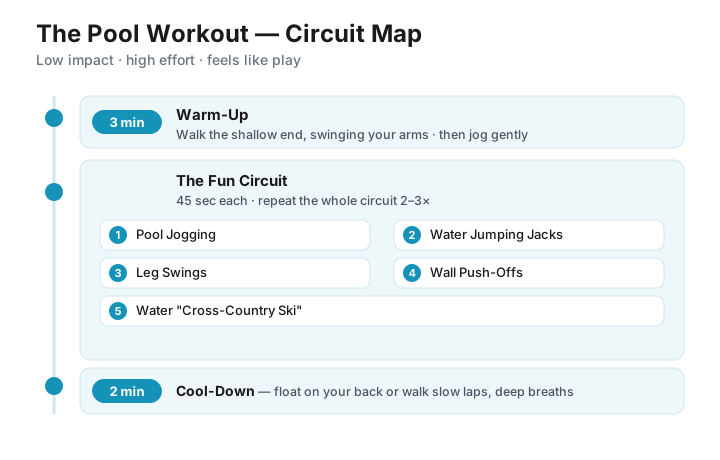
Here’s the full circuit mapped out before we jump in:
The Warm-Up (3 Minutes)
Walk across the shallow end, swinging your arms deliberately through the water. Then jog gently in place for a minute.
Feel how the water pushes back on your arms? That’s the resistance already doing its thing — which is why the warm-up in a pool is genuinely a warm-up and not just standing around.
What Is a Good Pool Workout Circuit for Beginners?
Five moves. 45 seconds each, 15 seconds transition, repeat the whole thing 2–3 times. Stay in chest-deep water for all of it unless noted.
1. Pool Jogging
Jog in place or travel across the pool, driving your knees up toward the surface. Your legs work hard; your joints barely notice. Drive the arms too — they’re what turns this from a leg exercise into a full-body one.
2. Water Jumping Jacks
Exactly what they sound like, but the water makes them harder and softer at the same time. Push your arms down through the water on the way in rather than letting them float — that’s where the resistance lives.
3. Leg Swings
Hold the pool edge and swing one leg front-to-back for 20 seconds, then side-to-side for 20. Switch legs. Hello, hips and glutes. Keep the standing leg slightly soft rather than locked.
4. Wall Push-Offs
Push off the wall with both feet, glide as far as you can, then paddle back. A little cardio, a little core, a lot of fun. This is the one adults skip because it feels like being nine years old, and it’s also the highest-intensity move on the list — the push-off is explosive leg work and the glide is a plank you don’t have to think about.

5. Water “Cross-Country Ski”
Scissor your arms and legs like you’re cross-country skiing in slow motion — opposite arm, opposite leg, big deliberate range. Full-body, low-drama, oddly relaxing. Good closer because it lets your heart rate settle while you’re still moving.
The Cool-Down (2 Minutes)
Float on your back if you can, or walk slow laps and take deep breaths. Let the water do what water does best.
Don’t skip this one for the reason people usually skip cool-downs. Water makes it pleasant, so there’s no excuse available.
Myth vs Fact: Pool Workouts
Myth: Water workouts are only for seniors or rehab. Fact: Aquatic training is a staple in professional athletics for exactly the same reasons — high resistance, low joint cost. The intensity ceiling is set by how hard you push, not by the medium.
Myth: You have to be able to swim. Fact: Every move in this circuit happens in chest-deep water with your feet on the bottom. Swimming ability is irrelevant. Deep-water running needs a flotation belt and is a separate thing entirely.
Myth: You don’t need to hydrate because you’re in water. Fact: You sweat in a pool — you just can’t see it. A 30-minute session in warm water dehydrates you meaningfully. Keep a bottle at the pool edge and actually drink from it.
Myth: If you’re not sweating, you’re not working. Fact: Sweat is a thermoregulation signal, not an effort meter. In a pool the water is doing the cooling, so the usual feedback loop is missing. Judge by breathing rate and how your muscles feel instead.
Mini FAQ
How many calories does a pool workout actually burn?
Roughly 250–400 for 30 minutes for most adults, depending on body weight and how hard you push. Water aerobics sits around the same range as a brisk walk-jog; harder circuits with big arm drive land closer to a moderate run. The comparison people find surprising is that it’s in the same neighborhood as land cardio despite feeling considerably easier.
How often should you do pool workouts?
Three to four sessions a week is a reasonable target, and because the joint load is so low you can generally go more often than you would with running. If it’s your only cardio, 30 minutes three times a week is a solid floor. Add one or two land-based strength sessions if bone density is a concern — water’s biggest weakness is that it doesn’t load the skeleton.
Do you need any equipment?
No, and that’s most of the appeal. Foam dumbbells, resistance gloves, and ankle floats all increase difficulty if you want them later, but the circuit above needs a pool, a swimsuit, and a wall. A pair of water shoes helps if the pool floor is rough.
TL;DR:
- Water is 800× denser than air, so every direction resists — while buoyancy removes 80–90% of joint load.
- 30 minutes burns roughly 250–400 calories, comparable to brisk land cardio.
- Circuit: pool jogging, water jacks, leg swings, wall push-offs, cross-country ski — 45 seconds each, 2–3 rounds.
- Warm up 3 minutes, cool down 2. Stay in chest-deep water; no swimming ability required.
- You do sweat in a pool, you just can’t see it — drink water, and judge effort by breathing rather than sweat.
A solid 30 minutes in the pool can burn as much as a brisk land workout, and you’ll walk away refreshed instead of wrecked. If you’re managing a heart condition, a recent surgery, or a joint injury, run the plan past your doctor or a physical therapist first — aquatic exercise is usually the recommended option in those situations, but the specifics matter.
Otherwise: just a pool, a swimsuit, and a willingness to look a little silly. That last part is the whole point. Go make a splash — your body barely knows it’s exercising.
Keep Reading
This article is for general informational purposes only and is not medical advice. It is not a substitute for professional diagnosis or treatment. Always consult a qualified healthcare provider about your individual situation, especially before making significant changes to your diet or exercise routine.