Your First Swim Training Plan: From Casual Laps to Structured Sessions
Quick Answer: A beginner swim training plan is three 30–40 minute sessions a week, built from short repeats with rest instead of one long continuous swim. Start with 4x50s in week one, add intervals in week two, nudge volume in week three, and finish week four with a timed 200 as your benchmark. Structure — not more pool time — is what breaks the plateau.
You’ve been swimming the same twenty minutes for two years. Same lane, same pace, same slightly bored feeling at minute fourteen. And your fitness hasn’t budged since the second month.
That’s not a talent problem. It’s a structure problem. Here’s the plan that fixes it.

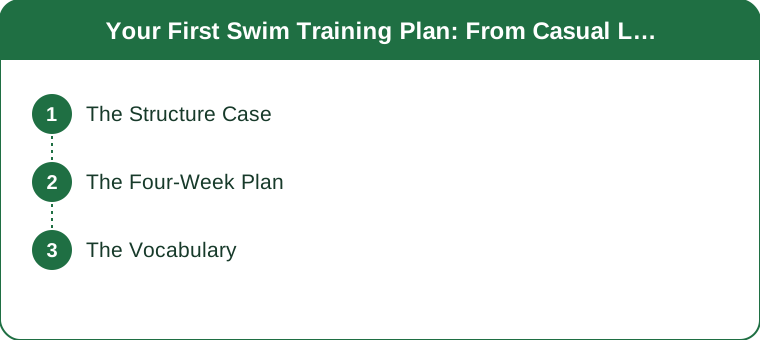
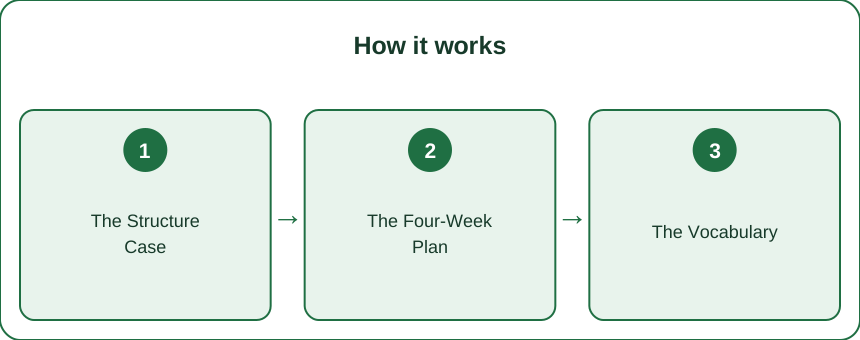
Why Do Structured Swim Workouts Beat Continuous Laps?
Because rest lets you swim faster, and faster is where adaptation lives. Swim 8x50 with 20 seconds of rest and you’ll hold a pace you physically cannot hold for a straight 400. Same total distance, meaningfully harder stimulus.
Technique is the second argument. Form falls apart somewhere around minute eight of continuous freestyle — the hips drop, the catch gets sloppy, and you spend the back half rehearsing bad habits. Short repeats keep the stroke intact because you’re never swimming tired enough to abandon it.
Then there’s the part nobody admits: continuous laps are boring. A session with parts has a shape and an ending. The eternal back-and-forth has neither, which is why so many lap swimmers quietly stop showing up.
And the honest reason your fitness stalled: you’ve given your body the identical stimulus for 100 straight sessions. Bodies adapt to a stimulus and then stop caring about it. Structure is how you keep changing the question.
What Does the Four-Week Beginner Swim Plan Look Like?
Three sessions weekly, 30–40 minutes each. Scale every distance to your level — the structure is the plan, the numbers are yours.
Week 1 — Baseline. Each session: 100 easy warm-up, 4x50 easy with rest as needed, 4x25 focused purely on one technique cue, 100 easy cool-down. Rest as needed is not cheating in week one; it’s the whole design.
Week 2 — Intervals arrive. 200 warm-up, 6x50 at steady effort with 20–30 seconds rest, 4x25 at “fast-ish,” 100 kickboard, 100 cool-down. This is the week the pool clock becomes a training partner.
Week 3 — Volume nudge. 200 warm-up, 8x50 main set, 2x100 continuous blocks, 100 cool-down. Add breathing-pattern work here — bilateral every 3 strokes on the 100s.
Week 4 — Test week. Warm up properly, then swim a timed 200 all-out. Write the number down. Then repeat the whole four weeks with rest intervals tightened by 5 seconds.
The weekly shape matters as much as the sets: one technique-focused session, one interval session, one longer steady session. Newer swimmer? Halve every distance. The skeleton still works.

How Do You Read a Swim Workout?
Swim workouts look like code because they are. Four terms unlock the whole language.
- Set notation. “4x50” means four repeats of 50 meters. What follows is either the rest (“4x50, :20 rest”) or the send-off (“4x50 @ 1:15”).
- Send-off. Leave every 1:15 on the pace clock. Swim it in 1:00 and you’ve earned 15 seconds of rest. Swim it in 1:10 and you’ve earned 5. The clock enforces honesty better than willpower does.
- Main set. The session’s actual work. Everything else is scaffolding.
- Effort scale. Easy / steady / strong / fast. Steady is conversational-ish. Strong is the last three reps hurt. Fast means you’re not finishing eight of them.
A session template you can reuse forever: warm-up, drill set, main set, cool-down. Change one variable and you have a new workout. That’s infinite sessions from one structure.
5 Mistakes Almost Every New Lap Swimmer Makes
- Swimming every session at the same medium effort. Medium forever produces medium forever. You need one easy day and one genuinely hard set per week.
- Skipping the warm-up because 40 minutes feels short. The first 100 easy is what keeps your shoulders in the sport at year five.
- Treating rest as failure. The rest is the equipment. Without it you’re just doing a slow long swim with extra steps.
- Ignoring the pace clock entirely. Unmeasured swimming is unmeasurable progress. Learn to read it once and you use it forever — this is the one that surprises people most, because it costs nothing.
- Adding distance before adding quality. A tighter 8x50 beats a sloppier 1,000 nearly every time in the first year.
Do You Need Special Gear to Start?
Barely. Goggles that don’t leak, a suit that stays put, and a cap if you have hair to manage. A kickboard and pull buoy are usually free at the pool.
The one thing worth actual money is a suit with real chlorine resistance — a cheap one bags out at the seat within six weeks and you’ll spend every push-off adjusting it. A squat-proof, chlorine-resistant training suit solves the fidgeting and the transparency worry in one purchase, and it’s the difference between thinking about your set and thinking about your straps.
Frequently Asked Questions
How many times a week should a beginner swim?
Three sessions is the sweet spot for adaptation without burnout. Two works if life is full — you’ll progress, just slower. Four or more is worth it only once your technique holds up under fatigue, otherwise you’re accumulating volume on a flawed stroke.
How long before I see progress from a swim training plan?
Most people drop noticeable time on the 200 benchmark within the first four-week block, largely from pacing and efficiency rather than fitness. Real conditioning changes show up around week 8–12 of consistent three-a-week swimming.
Should I swim continuously if my goal is endurance?
Not exclusively. Build the engine with intervals, then include one longer steady swim weekly to practice pacing and mental rhythm. Endurance built on intervals transfers to continuous swimming much better than the reverse.
What if my pool is crowded and I can’t hold send-offs?
Use rest-based sets instead (“4x50, :20 rest”) rather than clock-based send-offs. You lose a little precision and none of the training effect. Circle-swim etiquette beats a perfect interval every time.
When to Check With a Professional
Swimming is famously joint-friendly, but shoulder pain that persists beyond a session or two is worth a physio’s opinion rather than a “swim through it” approach — swimmer’s shoulder is an overuse pattern that responds well to early attention and badly to being ignored. Anyone with a heart condition, uncontrolled blood pressure, or a recent surgery should get clearance before starting interval work, since intervals raise cardiovascular demand quickly.
TL;DR:
- Structure beats steady laps — rest-punctuated sets let you swim faster with better technique than continuous cruising.
- Three sessions weekly, 30–40 minutes: one technique, one interval, one longer steady.
- Four-week block: baseline 50s → intervals → volume → timed-200 benchmark. Then repeat with tighter rest.
- Learn four terms — set notation, send-off, main set, effort scale — and you can read or write any workout.
- Warm up, drill, main set, cool down. Same pool time, converted into actual training.
Keep Reading
This article is for general informational purposes only and is not medical advice. It is not a substitute for professional diagnosis or treatment. Always consult a qualified healthcare provider about your individual situation, especially before making significant changes to your diet or exercise routine.