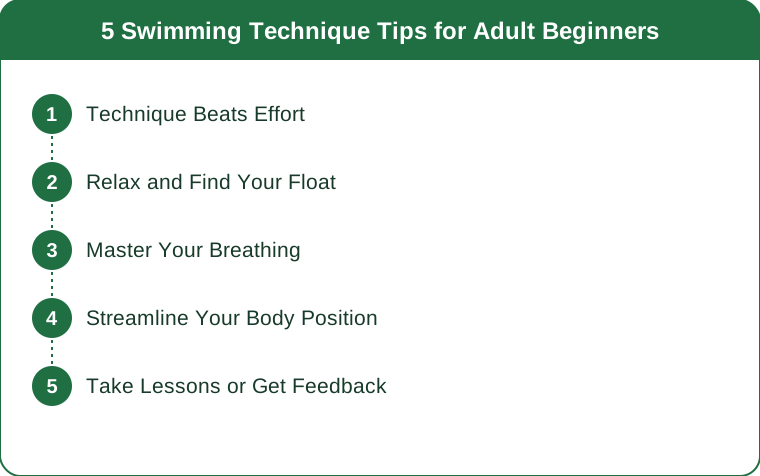
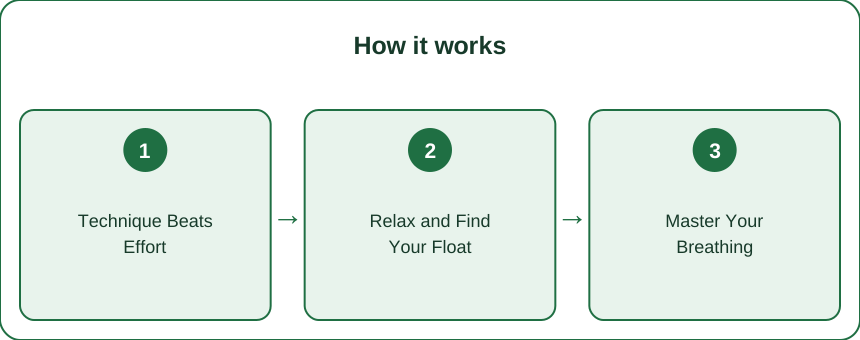
5 Swimming Technique Tips for Adult Beginners
Quick Answer: Adult beginners improve fastest by fixing four things in order: relax to float, exhale continuously underwater, keep your body long and flat near the surface, and kick from the hips, not the knees. Technique matters far more than fitness — a relaxed swimmer with a good body line covers a lap on a fraction of the effort of a strong one who’s fighting the water.
You push off the wall, thrash for 25 metres, and arrive at the other end genuinely out of breath — while the person in the next lane glides past looking like they’re doing considerably less work.
They are doing less work. That’s the whole thing.
Swimming is the rare sport where trying harder makes you slower, and the fix is almost never fitness.
Why Does Technique Matter More Than Fitness in Swimming?
Because water is roughly 800 times denser than air, so drag punishes you in a way it never does on a run.
On land, a fitter runner beats a less-fit one with similar form. In water, form dominates: reducing drag by improving your body position can cut the energy cost of a lap dramatically, while adding raw power to a bad position mostly just makes bigger splashes.
That’s why a relaxed 60-year-old with 30 years of pool time cruises past a gym-fit 25-year-old on their third lesson. It isn’t cardio. It’s efficiency.
The practical takeaway for an adult beginner: spend your first ten sessions on how you move, not on how far you go.
How Do You Learn to Relax and Float?
Tension is the beginner’s real enemy — a rigid body sinks at the hips, which drops the legs, which triples drag.
Try this in the shallow end, holding the wall:
- Take a normal breath, put your face in the water, and let your legs float up behind you.
- Do nothing. Don’t kick. Count to ten.
- Notice where you’re gripping — usually neck, shoulders and jaw — and let each one go.
Most people discover their body floats better than they believed, and the panic response is what was sinking them. A calm body floats; a braced one doesn’t.
Second drill: the star float on your back. Arms and legs wide, ears in the water, looking straight up. If your hips drop, press your chest gently down and your hips will rise — it’s a see-saw.
Everything that follows is built on this. Skip it and you’ll be fighting the water in every other drill.

What’s the Right Way to Breathe While Swimming?
This is the single hardest thing for adult beginners and the single most transformative once it clicks.
The rule: exhale continuously underwater, inhale quickly above it.
Beginners hold their breath face-down, then try to exhale and inhale in the fraction of a second their mouth is clear. It never works, and it’s why swimming feels suffocating.
Instead:
- Face in the water: hum out slowly through your nose and mouth, the entire time. Humming forces a steady exhale and stops water going up your nose.
- Turn your head to the side — don’t lift it. One goggle stays in the water.
- Inhale fast, then rotate straight back down and resume humming.
Practise it standing in the shallow end for two minutes before you swim: face in, hum, turn, sip air, repeat. Then try bobbing. Then add it to the stroke. Rushing this step is why people stall for months.
5 Mistakes Everyone Makes Learning to Swim as an Adult
- Lifting the head to breathe. The head goes up, the hips go down, and now you’re swimming uphill. Rotate, don’t lift.
- Kicking from the knees. Bicycle kicking creates enormous drag and almost no propulsion. The kick starts at the hip, legs long, ankles loose, small and fast.
- Swimming flat like a plank. Freestyle has body rotation — roughly 30–45° to each side. Rotation lengthens your reach and makes breathing easy instead of a scramble.
- Pulling with a straight, stiff arm. The catch happens with a high elbow and the forearm pressing water backwards, not down. The fourth mistake surprises people who’ve swum for years.
- Doing distance before doing form. Grinding out 40 laps of bad technique installs it permanently. Short sets with rest and attention beat volume, every time.
How Do You Get Feedback on Your Own Stroke?
You can’t see yourself swim, and you can’t feel most of what’s wrong — which is why swimmers plateau for years on habits that take one session to fix.
Three or four lessons with a coach will out-perform a year of solo laps. Ask specifically for a stroke assessment rather than a fitness session.
Have someone film you from the side, above water and below if possible. Thirty seconds of footage will show you exactly where your hips sit and what your kick is doing. It’s usually humbling and immediately useful.
Use drills as diagnostics. Kickboard work tells you about your kick. Single-arm freestyle tells you about your catch. Catch-up drill tells you about your timing.
Swim with people slightly better than you. Watching a good stroke from the next lane is free coaching.
When to see a professional: shoulder pain that persists after sessions, ear pain or persistent infections, or any dizziness in the water are worth a doctor’s look — shoulder issues in particular are best caught early, since they usually trace back to a technique fault that a coach can correct.
How long does it take an adult to learn to swim?
With regular practice — two or three sessions a week — most adults can swim a comfortable, continuous 25 metres within 6 to 10 weeks. Breathing rhythm is usually the rate-limiting step, not fitness.
Is it harder to learn to swim as an adult?
Different, not harder. Adults learn the mechanics faster because they can follow instruction, but they carry more tension and self-consciousness into the water. The physical learning is easy; the relaxation is the work.
Should I learn freestyle or breaststroke first?
Breaststroke is often easier to start with because your head stays above water, which removes the breathing panic. Freestyle is more efficient long-term. Many coaches teach basic floating and breathing first, then freestyle, with breaststroke as a comfortable fallback.
TL;DR:
- Water is 800× denser than air — drag beats fitness, so form comes first.
- Relax to float. Tension sinks the hips; a calm body floats.
- Exhale continuously underwater (hum), inhale fast, rotate — never lift the head.
- Stay long and flat, rotate 30–45°, and kick small and fast from the hips.
- Short technique sets beat long grinding sets. Volume installs whatever form you have.
- Three or four lessons or a 30-second video will fix things you can’t feel.
Keep Reading
This article is for general informational purposes only and is not medical advice. It is not a substitute for professional diagnosis or treatment. Always consult a qualified healthcare provider about your individual situation, especially before making significant changes to your diet or exercise routine.