Swimming Workouts for a Full-Body Burn (Beginner-Friendly)
You spend twenty minutes doing laps and somehow feel like you’ve done a full-body strength session and a cardio class at once, minus the sore knees the next morning. That’s the strange magic of the pool — it works harder than it feels like it should.
Quick Answer: Swimming delivers a full-body, joint-friendly workout by combining cardio, strength, and endurance training against water resistance with virtually no impact on your joints. Beginners can start with short interval sets — a few easy laps, a main set of 8 to 10 laps with rest between, then a cool-down — and build gradually from there. If lap swimming feels intimidating, water aerobics and pool exercises deliver similar benefits without needing to swim continuous laps.
Swimming might be the most underrated workout there is — a full-body, joint-friendly, seriously effective form of exercise that somehow doesn’t feel as brutal as it works. Whether you’re a confident swimmer or just getting comfortable in the water, there’s a version of this workout for you. Here’s how to use the pool for a genuine full-body burn.

Why is swimming such an effective full-body workout?
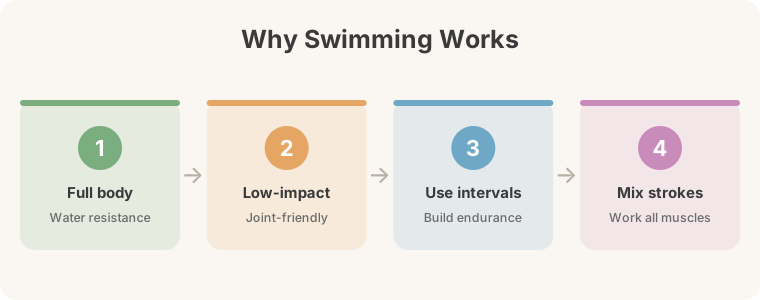
Swimming works your entire body against water’s resistance while being gentle on your joints — a rare combination that most land-based workouts can’t offer. You build cardio, strength, and endurance all at once, with virtually no impact on your knees, hips, or ankles. That’s why it’s brilliant for everyone from complete beginners to people managing joint concerns: full-body results, zero pounding. The water itself does a meaningful share of the work with you, resisting every stroke and kick evenly in every direction.
What’s a good beginner swimming workout?
You don’t need to swim for an hour straight to get results — a short, structured set beats an unstructured, exhausting one.
Start with intervals, not endurance swims
Rather than swimming until you’re exhausted, try intervals: swim one lap, rest 20 to 30 seconds, repeat. This builds endurance manageably and keeps your form intact, which matters more for results than raw distance.
A simple beginner set to try
- Warm up: 2–4 easy laps
- Main set: 8–10 laps with short rests between (build this up over several weeks)
- Mix strokes if you can — freestyle, backstroke — to work different muscle groups
- Cool down: 2 easy laps
No lap swimming? Try water workouts instead
Not a confident swimmer? Water aerobics and pool exercises — water jogging, leg lifts, arm movements — give a great low-impact workout without requiring you to swim laps at all. You get the same joint-friendly resistance benefit standing in chest-deep water.
Build gradually, not all at once
Start with whatever you can currently do and add laps or reduce rest as your fitness improves over a few weeks. Progress at your own pace — the water rewards patience more than it rewards pushing hard on day one.

What tips actually make a swim workout more effective?
- Focus on form — efficient strokes matter more than raw speed for both results and injury prevention
- Use intervals — build endurance without burning out in the first ten minutes
- Mix it up — different strokes work different muscle groups, so variety adds more coverage
- Stay consistent — regular swims, even short ones, build fitness faster than occasional long ones
- Try water workouts — a legitimate option if lap swimming isn’t for you, not just a fallback
Myth vs Fact: Swimming Workouts
- Myth: You need to be a strong swimmer to get a good workout. Fact: water aerobics and pool exercises give a comparable full-body, low-impact workout without requiring laps at all.
- Myth: Swimming doesn’t build strength, only cardio. Fact: water resistance works your muscles in every direction of movement, which is a form of resistance training even though it doesn’t feel like lifting weights.
- Myth: More laps always means a better workout. Fact: short, well-structured interval sets with good form typically beat long, sloppy swims for both results and injury prevention — quality over sheer distance.
- Myth: Swimming is only cardio, so it won’t tone your body. Fact: the combination of resistance and range of motion across a full stroke cycle works your arms, back, core, and legs in ways many land workouts don’t. (This one surprises even people who’ve swum for years.)
How many times a week should a beginner swim?
Two to three sessions a week is a reasonable starting point for most beginners, giving your body enough recovery time between sessions while still building consistency.
Is swimming enough exercise on its own?
For many people, yes — swimming touches cardio, strength, and endurance in one session, though pairing it with occasional land-based mobility work can round things out further.
Should I check with a doctor before starting swim workouts?
If you have a heart condition, an injury, or any concern about impact on a specific joint, it’s worth checking with a doctor or physical therapist before starting, since they can tailor intensity and stroke choice to your situation.
TL;DR:
- Swimming gives a full-body, joint-friendly workout in one session
- Beginners should start with intervals, not endurance swims
- A simple set: 2–4 warm-up laps, 8–10 main laps, 2 cool-down laps
- No lap swimming? Water aerobics delivers similar benefits
- Build gradually — add laps or cut rest time as fitness improves
Swimming workouts deliver a full-body, joint-friendly burn — use intervals to build endurance, mix your strokes, and progress gradually, or try water aerobics if laps aren’t your thing. It’s effective, low-impact exercise that works your whole body at once. Dive in and discover one of the best workouts around. This article is for general wellness purposes only and isn’t medical advice.
Keep Reading
This article is for general informational purposes only and is not medical advice. It is not a substitute for professional diagnosis or treatment. Always consult a qualified healthcare provider about your individual situation, especially before making significant changes to your diet or exercise routine.